title:: An integrated framework for finite-element modeling of mitral valve biomechanics from medical images - Application to MitralClip intervention planning
publisher:: Elsevier
people:: Tommaso Mansi, Ingmar Voigt, Bogdan Georgescu, Xudong Zheng, Etienne Assoumou Mengue, Michael Hackl, Razvan Ionasec, Thilo Noack, Joerg Seeburger, Dorin Comaniciu
organization:: Siemens Corporate Research, Leipzig Heart Institute, Friedrich-Alexander-Universität Erlangen-Nürnberg
domain:: Medical Imaging, Biomechanics, Machine Learning, Computational Modeling, Cardiology
link:: https://doi.org/10.1016/j.media.2012.05.009
citations:: 106 (OpenAlex) · 118 (Semantic Scholar) — as of 14 October 2026
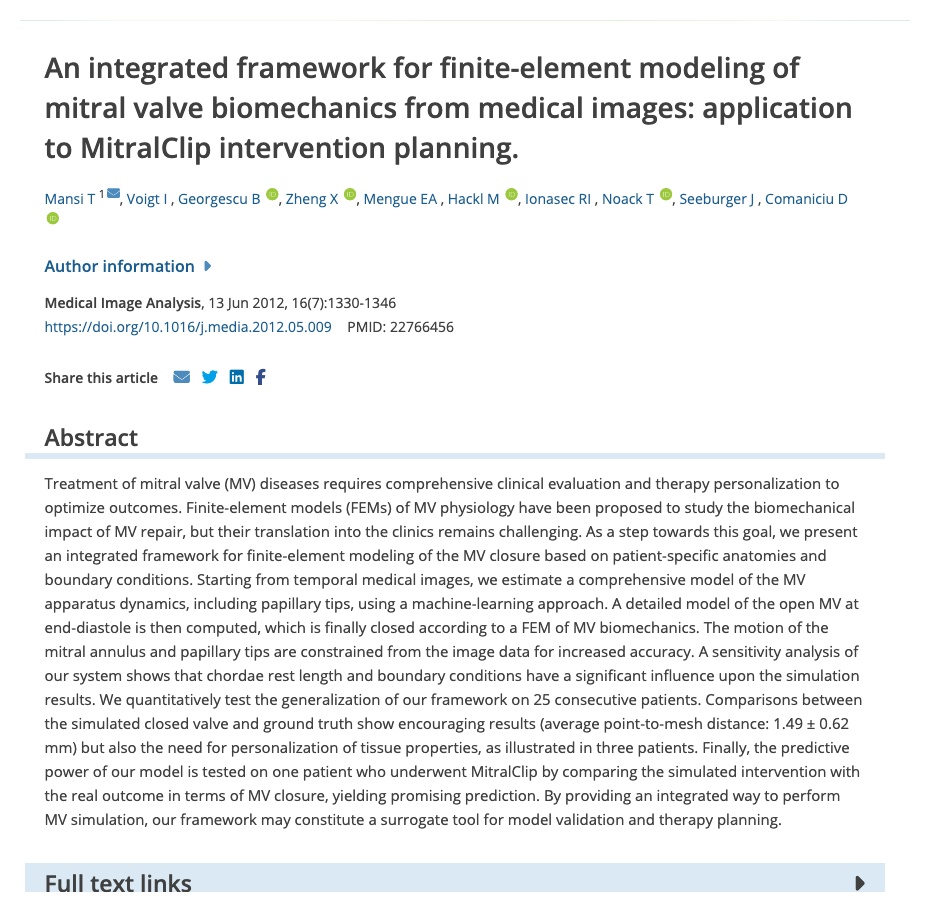
Article record — Europe PMC.
Summary
Finite-element models of mitral valve physiology had been proposed before, but translating them into the clinic was the hard part. This paper builds the integrated path: from temporal medical images to a comprehensive machine-learned model of the mitral valve apparatus including the papillary tips, then a detailed model of the open valve at end-diastole, then closure simulated under a finite-element model of valve biomechanics, with the annulus and papillary tip motion constrained directly from the image data.
A sensitivity analysis identifies chordae rest length and boundary conditions as the parameters that genuinely move the result - the honest finding that patient-specific tissue properties, not just patient-specific geometry, are what the method still needs. Predictive power is tested on a MitralClip patient by comparing the simulated intervention against the real outcome.
Data Points
- End-to-end: images to machine-learned valve apparatus model to finite-element closure simulation
- Annulus and papillary tip motion constrained from image data to raise accuracy
- Sensitivity analysis: chordae rest length and boundary conditions dominate the simulation outcome
- Generalisation tested on 25 consecutive patients; average point-to-mesh distance 1.49 ± 0.62 mm
- Predictive test on one MitralClip patient: simulated intervention compared against the real post-procedure outcome
- Identifies personalisation of tissue properties as the remaining gap - illustrated on three patients
Reference
Medical Image Analysis 16(7):1330-1346, 2012. doi:10.1016/j.media.2012.05.009 · PubMed 22766456
106-118 citations (OpenAlex / Semantic Scholar, October 2026)
Part of the complete record in Scientific Publications - Peer-Reviewed Research Record.