title:: Non-Invasive Hemodynamic Assessment of Aortic Coarctation - Validation with In Vivo Measurements
publisher:: Springer
people:: Lucian Itu, Puneet Sharma, Kristóf Ralovich, Viorel Mihalef, Razvan Ionasec, Allen Everett, Richard Ringel, Ali Kamen, Dorin Comaniciu
organization:: Siemens Corporate Research, Johns Hopkins University, Johns Hopkins Medicine, Technical University of Munich, Transylvania University of Brașov
domain:: Computational Fluid Dynamics, Medical Imaging, Clinical Applications, Cardiology
link:: https://doi.org/10.1007/s10439-012-0715-0
citations:: 78 (OpenAlex) · 78 (Semantic Scholar) — as of 14 October 2026
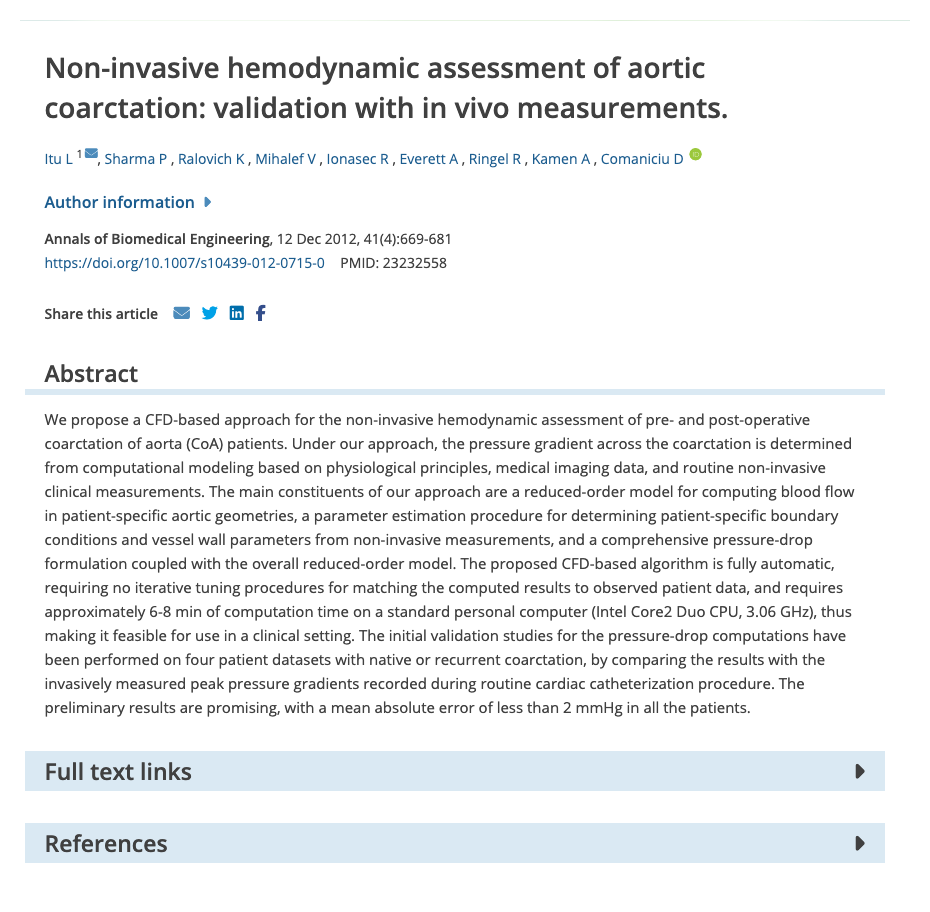
Article record — Europe PMC.
Summary
This is the paper that answers the question every simulation result eventually has to face: how do you know the model is right? A CFD-based approach computes the pressure gradient across an aortic coarctation from physiological principles, imaging data and routine non-invasive clinical measurements - then the computed pressure drop is compared directly against the invasively measured peak pressure gradient recorded during cardiac catheterisation.
Three components make it clinically usable rather than merely correct: a reduced-order model for blood flow in patient-specific aortic geometries, a parameter estimation procedure that derives patient-specific boundary conditions and vessel wall parameters from non-invasive measurements, and a pressure-drop formulation coupled into the reduced-order model. No iterative tuning to match observed patient data, and 6-8 minutes on a standard desktop PC.
Data Points
- Computed pressure gradient validated against invasive catheter measurement in four patients with native or recurrent coarctation
- Mean absolute error below 2 mmHg in all patients
- Fully automatic - no iterative tuning procedure to match computed results to observed patient data
- 6-8 minutes computation on a standard personal computer (Intel Core2 Duo, 3.06 GHz), making it feasible in a clinical setting
- Reduced-order flow model plus non-invasive parameter estimation for boundary conditions and vessel wall properties
- The validation-against-physical-measurement reference point for the whole simulation line of work
Reference
Annals of Biomedical Engineering 41(4):669-681, 2012. doi:10.1007/s10439-012-0715-0 · PubMed 23232558
78 citations (OpenAlex and Semantic Scholar agree, October 2026)
Part of the complete record in Scientific Publications - Peer-Reviewed Research Record.